







Written by: Lindsay Kuula
Date: May 6th, 2026
Read Time: ~10 mins
I am a mom doing my best to reduce screen time as much as possible. I’ve made it a priority to only allow screens in a few scenarios (fevers/sickness, cutting nails/hair, + other similar situations like that).
However, I am getting to the point now where I see how screen time could give me a break, and sometimes I really really could use that.
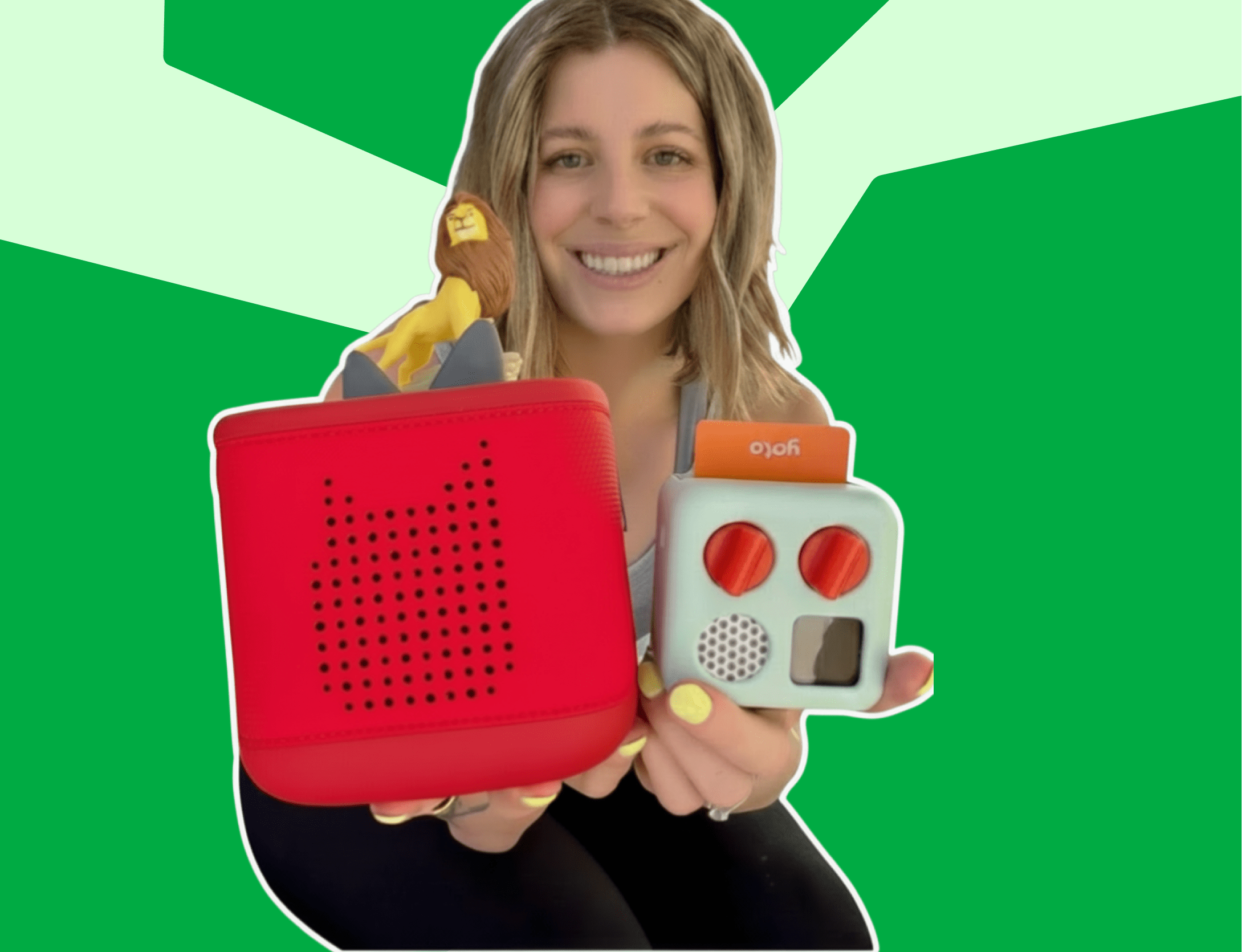
So when the Tonies vs. Yoto Player both started showing up everywhere (in my mom groups, on my FYP, on every single gift guide for kids ages 2-6), promising to help keep a toddler’s attention without screentime, I decided to try them both.
I buy and use the products for weeks to fully grasp the pros and cons of each. We are a toddler household (who’s very hard on things I might add) and I use him as my product tester. So, $200+ in Tonie and Yoto products + accessories later, I have some thoughts.
I’ll give you features where it matters but mostly, I’m here to tell you what these things actually do for your life. So when comparing Tonies vs Yoto, I did just this.
My short answer: Yoto is the better long-term buy. But Tonies might be the right short-term one, depending on your kid’s age. Let me explain.
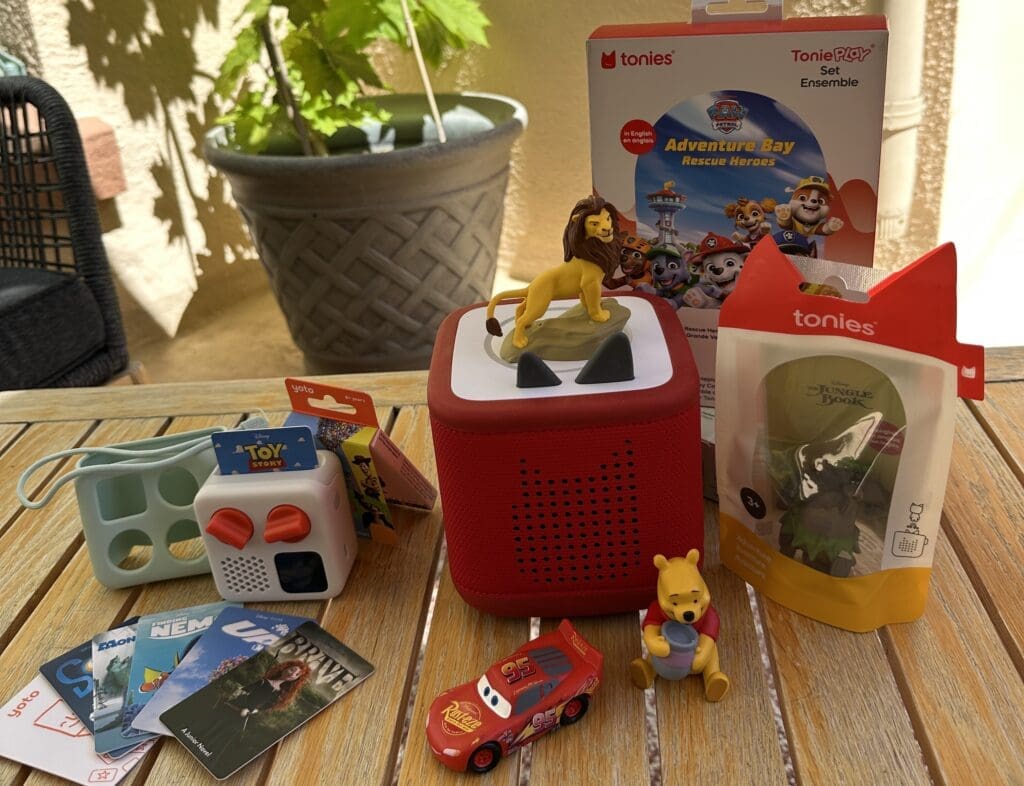
Table of Contents
Here’s The TLDR of which is best: Tonies vs Yoto
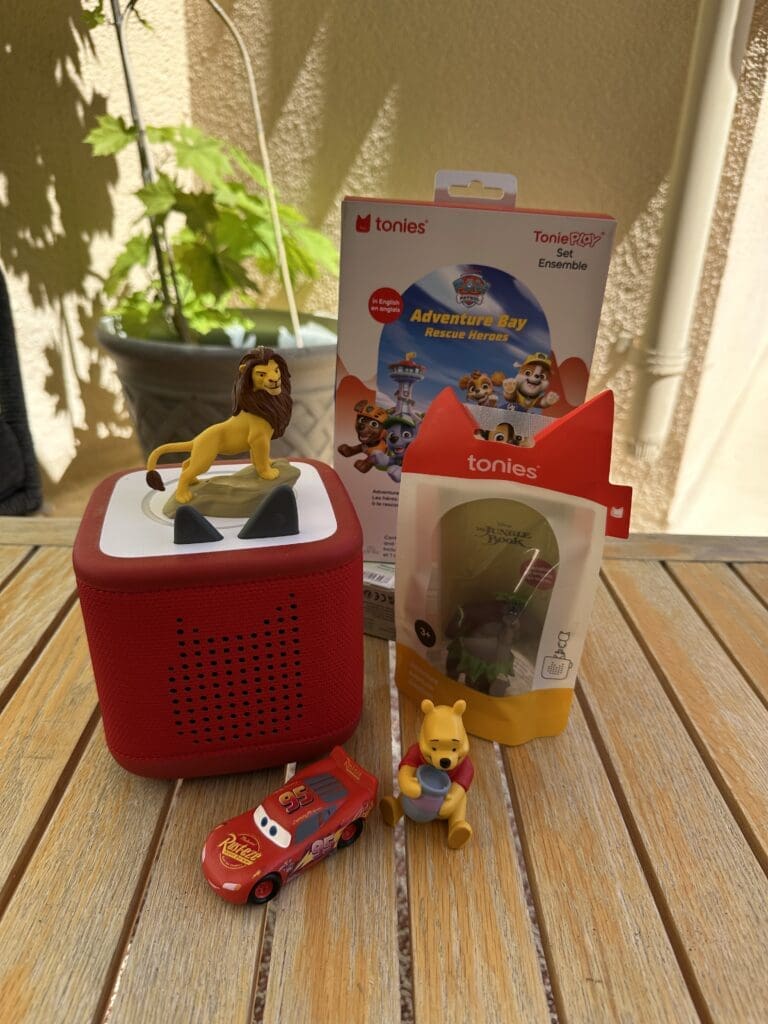
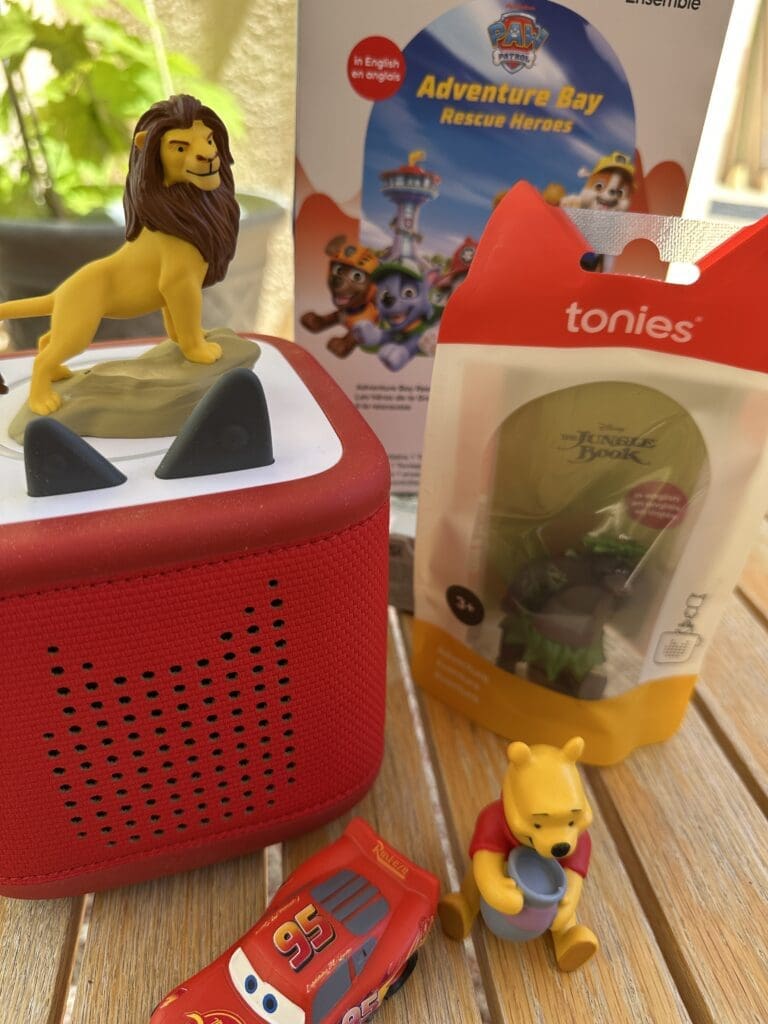
Tonie box is a magical, tube that is excellent for younger toddlers. It’s a fun, tactile experience, that’s basically indestructible.
There’s songs at the beginning of the Tonie, the story on the second half, and they’ve done a great job of making this content entertaining… for long durations. My 2 year old LOVES it. It’s intuitive, and is a the better option, for the short term.
The Yoto player has done an excellent job at making a product for long term use. It’s best for later stage toddlers or children, who enjoy stories and audio books, think (which I’m being nostalgic here) boxcar children, Chronicles of Narnia, etc.
Yoto has a massive library, and while I am saying Tonies are great for young toddlers, Yoto does have content specific for that stage too.
One of the biggest differences that I want to call out (that is favorable to Yoto) is that if your kid loses a card, that content is not lost. You will have it stored in a library on your phone, that you can still push onto the Yoto Player if your kiddo wants to listen to that card.
The same is not true for Tonies. If you lose a figurine, even though the app says you have it, it does not connect from your phone to the Tonies Box directly and you will need to buy a new figurine.
Yoto has quite a few additional features that Toniebox doesn’t, and for some parents, this might be the deciding factor. For others, Tonie Box offerings are exactly what they need in this stage.
So let’s get into the details:
What Are Screen Free Audio Players?
Both the Toniebox and the Yoto Player are screen-free audio players designed for kids that provide 0 access to the internet. No YouTube. No shows, which means no negotia ting over ‘one more episode’ because that next episode was teased out. You hand your toddler a physical object they interact with, and only audio plays.
The how is where they differ.
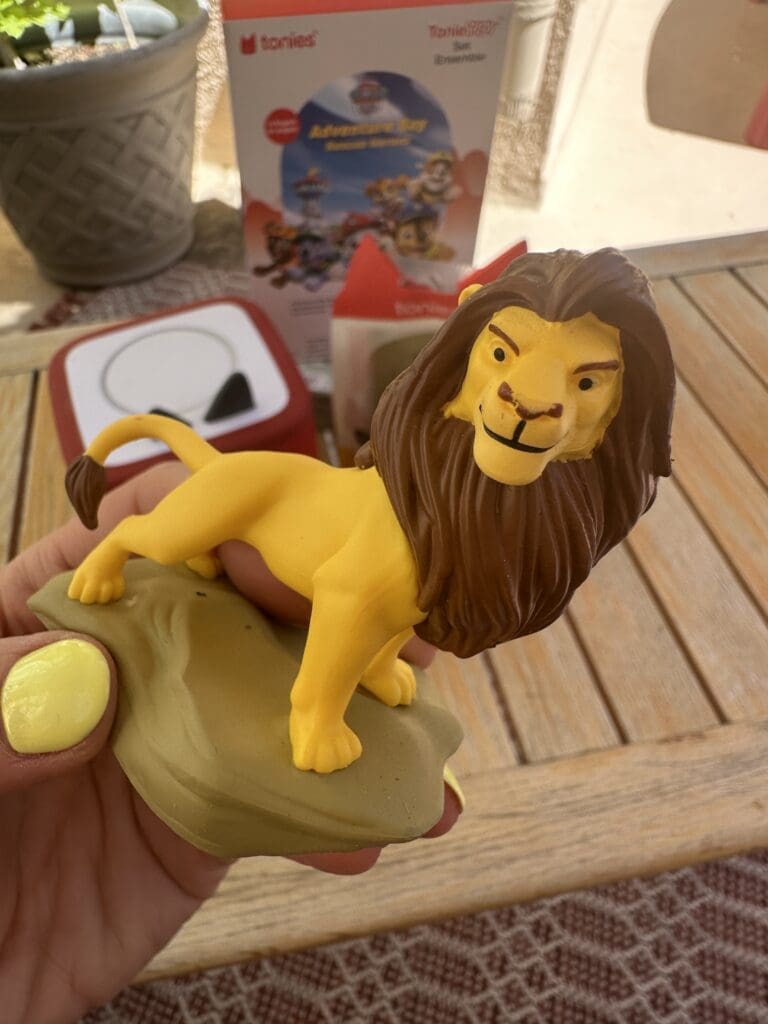
Toniebox uses small, magnetic figurines called Tonies. You place the Tonie character on top of the soft cube-shaped box, and it plays whatever story, song, or content that character holds. It’s tactile, it’s magical for little hands, and it’s quite durable.
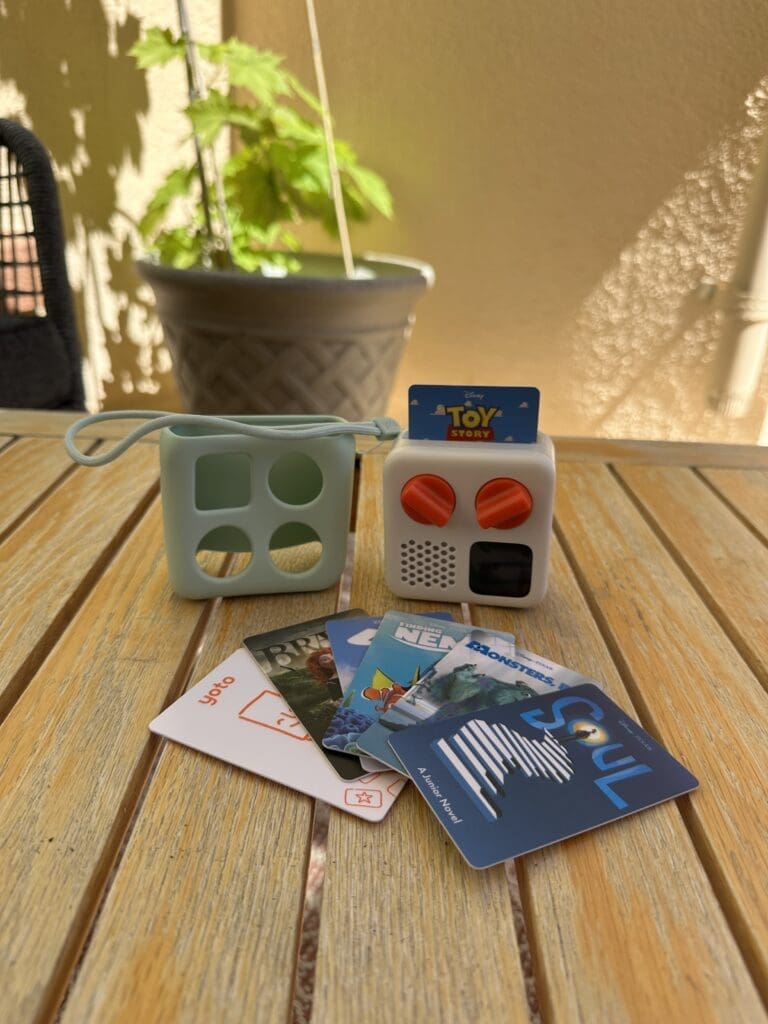
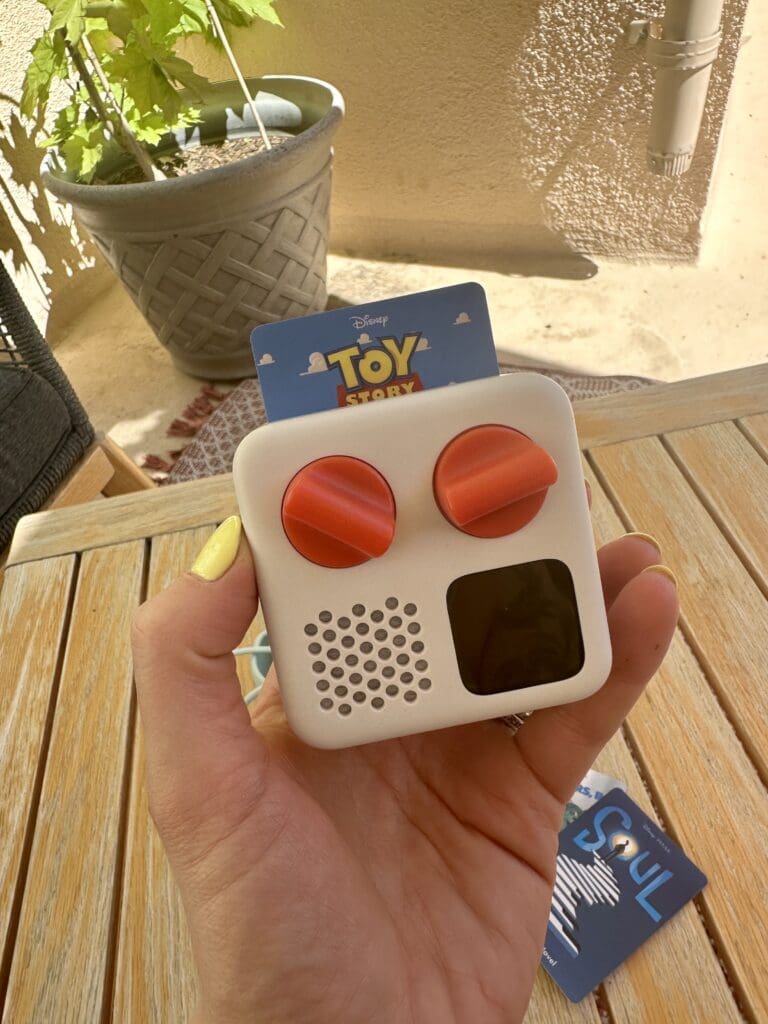
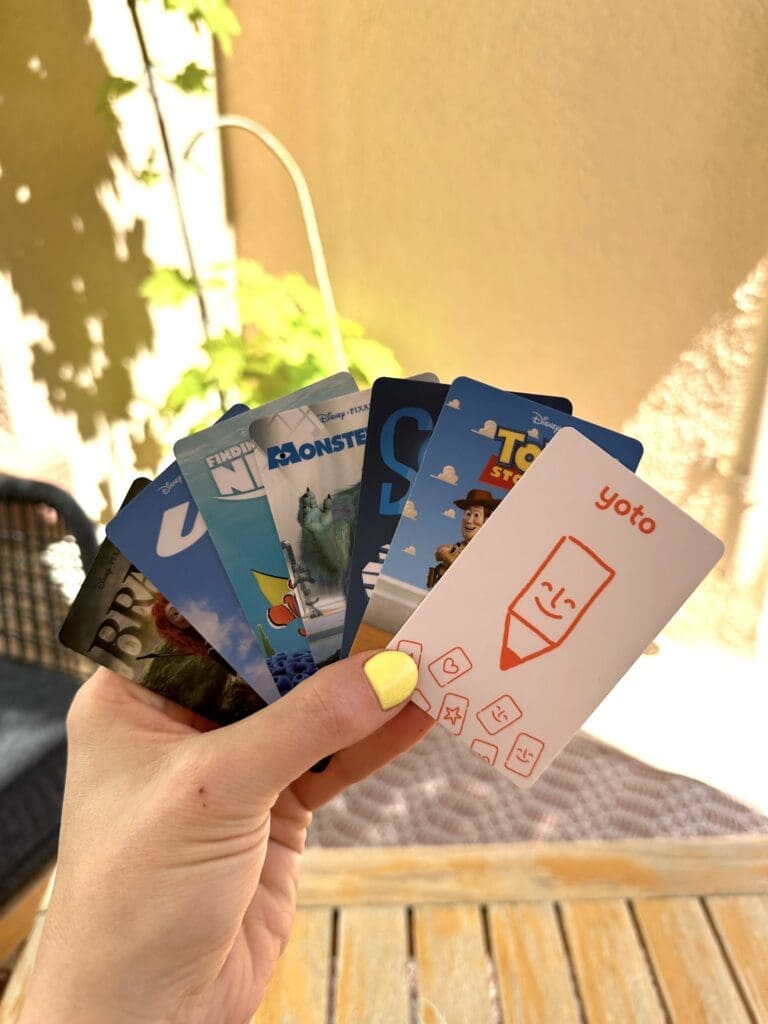
Yoto Player uses small physical cards. Think modern cassette tapes, that are credit-card sized. They slot into the top of the device. The card triggers the content, a tiny pixel image lights up on the front display, and audio plays. It also functions as a clock, nightlight, Bluetooth speaker, alarm, and routine timer. It does a lot more than play stories.
First Impressions of Tonies vs Yoto
Toniebox: The box itself is soft, covered in fabric, and noticeably durable. It feels quality in a way you don’t always get in kids’ products.
The characters are fun and they have multiple product lines. The ease of use for a young toddler is there, mine understood what how to use it immediately.
That said, for me, one thing annoyed me right away.
To change chapters, you physically hit the side of the box. Which, I can recognize is fun for little kids. Except there’s no indicator of which chapter you’re on. There’s a sound effect when you cycle through, but no visual, no number, nothing.
You actually have to hit the box quite hard, on the correct side. For me personally, counting audio cues while trying to locate the chapter we’re on, didn’t feel extremely intuitive to me.
I also don’t love the size of the Tonies (which I know i know, is also the charm). But as a Mom who’s already trying to reduce the volume of baskets needed for all the toys we have, this seems like it’s an addition to an ongoing secondary problem.
Yoto Player: First impression? There’s so much more going on, but in a good way. The pixel display on the front of the player is minimal, it shows the card’s custom image, the time, whether it’s day or night.
The buttons start to make sense after you spend five minutes with them. It’s not as immediately intuitive for the younger toddlers, but overall, it offers quite a bit more than just an audio player.
Like what you ask? We’re talking nightlight, sound machine, alarm clock, and routine timer. All in one device. I had no clue idea these features also existed when I first bought it. Surprise and delight. 🙂
The Case for Tonies
Here’s the thing Tonies gets right: the tactile experience for little kids is unmatched.
Placing a physical character on top of the box to make it play? That’s developmental intention for a two-year-old. It’s cause and effect. And, it’s play.
The Tonie figurines are sized perfectly for small hands, they’re satisfying to pick up and place with the magnetic pull, and I can see how kids would love collecting them, while my bank account does not…
The character lineup is also solid for young kids: Disney, Pixar, PAW Patrol, Peppa Pig, PBS Kids, DreamWorks, Dr. Seuss, Roald Dahl, Julia Donaldson. There’s a nice library of brands that your toddler might already know and love, which makes this even more magical for them.
The Creative Tonie is worth mentioning as well. These are blank figurines that you can upload your own audio to, up to 90 minutes. Grandma can record a bedtime story. You can load a playlist. You can delete and reuse them as many times as you want, which softens the price a little.
For the younger toddler years? The Toniebox is the better choice.
The Case for Yoto
Yoto is quite different than Tonies. Where Tonies leans into the toy experience for young kids, Yoto leans into utility, and the magic of storytelling.
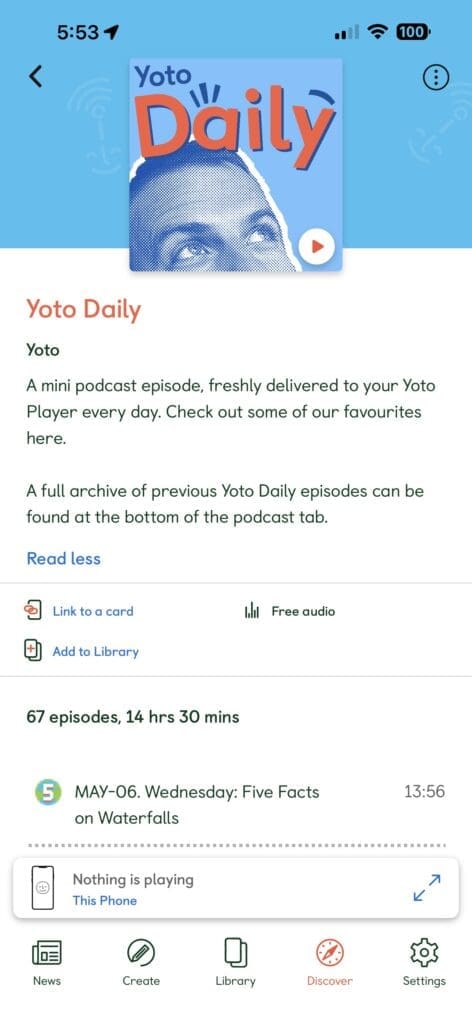
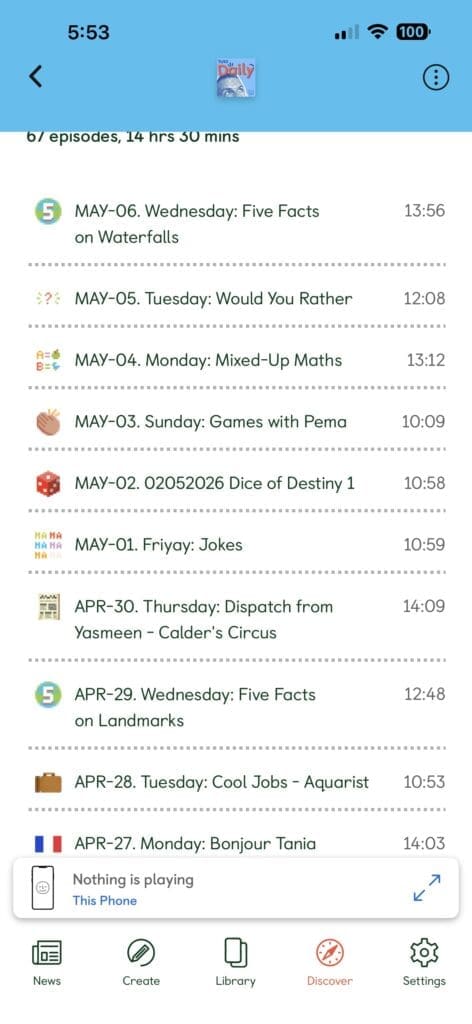
The Yoto Daily is free content that updates every single day. New stories, new mini-podcasts, new music. Zero cost, and no card needed. Yoto Radio is also built in and free.
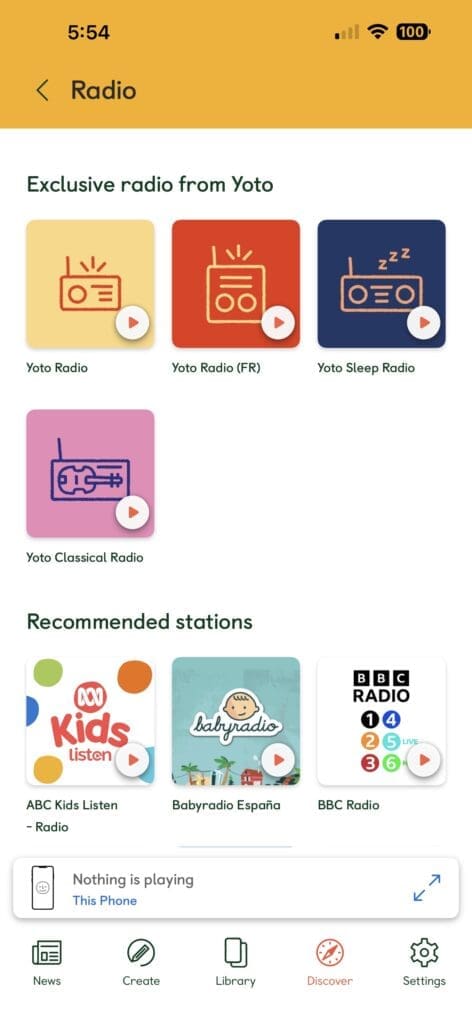
The Make Your Own cards are similar to the creative tonie. You can load them with whatever content you want, like podcast episodes, audiobooks you’ve downloaded, custom recording, and each card holds up to 100 tracks or 500MB of audio.
Then there’s the features that aren’t the big hitters but everyone ends up loving:
- Customizable alarms (school alarm vs. weekend alarm)
- Routine timer on the right-hand button (set it for teeth brushing, getting dressed, whatever)
- Okay-to-wake nightlight in seven colors — yes, you can use it as a sunrise alarm for your kid
- Bluetooth speaker which means you can play anything through it, not just Yoto cards
- Volume control from the parent app — so when your kid wants to crank it to maximum at 6am, you have full control.
- Pro Tip: Library sharing — You can share cards digitally with friends!
Head-to-Head Comparison: Tonies vs Yoto
Content Library
Both brands carry the big hitters: Disney, PAW Patrol, Roald Dahl, Dr. Seuss. Tonies has a slight edge in breadth of beloved character IPs for the toddler-to-preschool set, and that tactile-figurine experience makes those characters feel more special.
Yoto pulls ahead in older kid content — there are over 100 cards specifically in the 8-12 age category, and their library spans chapter books, educational content, foreign language learning, and podcasts. Tonies content skews younger and stays there.
Winner for toddlers: Tonies
Winner for longevity: Yoto
Cost Per Story
Yoto wins by a landslide here:
| Toniebox | Yoto Player | |
|---|---|---|
| Device Price | ~$129.99 | ~$79.99 or $109.99 |
| Content Cost | $19.99 per Tonie | $9.99–$14.99 per card |
| Free Daily Content | Limited | Yes — Yoto Daily + Radio |
| DIY Content | Creative Tonie (up to 90 min) | Make Your Own (up to 500MB) |
Tonies all cost the same regardless of content length. A three-minute silly song costs as much as a two-hour audiobook. Every single one is $19.99. Yoto cards tend to run $9.99–$14.99 and hold significantly more content per dollar.
Factor in the Yoto Daily, Yoto Radio, and Make Your Own cards, the long-term cost of the Yoto ecosystem is lower.
Winner: Yoto
Battery Life
Toniebox: ~7 hours.
Yoto Player: ~24 hours.
I’ll let that math speak for itself. For Tonies vs Yoto, on a long travel day, or just a week of heavy use without remembering to charge it, this does make a difference.
Winner: Yoto
Free Content
Toniebox does offer free stories you can listen to, but you need to download them onto a Creative Tonie. That’s an additional purchase. Plus, the free content footprint is a bit more limited than Yoto. The other thing is you cannot play any of the free content through your app/phone, so you’re completely bound to these figures.
Yoto’s free tier feels like there’s quite a bit more value: Yoto Daily (a new podcast or story every single day), Yoto Radio, and the ability to pull in free audiobook content from library apps like BorrowBox or Libby and load it onto Make Your Own cards. If you’re willing to spend a little time setting it up, the free content keeps coming.
Yoto’s introduction card (the onboarding essentially) can be wiped to make it a blank card. So you automatically have 1 blank card to download your own content to.
Tonies does not offer this. You have to buy at least 1 creative tonie to listen to any free content.
Plus with Yoto, you can play anything (the cards or free content yoto offers) through your phone. Tonie box does not have this option, it’s either the box or nothing.
Winner: Yoto
Volume & Sound Quality
Both devices have solid audio and sound quality. They both get loud enough without being ear splitting.
Read this: Yoto has parent-controlled volume limits through the app, that can be changed in real time, which I consider a strong selling point.
Toniebox also has parent-controlled volume limits, however, they can not be changed in real time, and are set in advanced.
Neither device is going to replace your Sonos. Both are perfectly good for a child’s room or car use. Toniebox does seem to get slightly louder, which, depending on the day, can be a pro or a con.
Winner: Tie, slight edge to Yoto for real time parental control
Age Range & Longevity
This might be the most important category for deciding which one is best for your family right now.
Toniebox: Best for ages 18 months to about 4-5. The soft cube, the figurine mechanic, the shorter content, it’s perfectly designed for the toddler and preschool window. After that, many families find their kids have “outgrown” the Toniebox.
Yoto: Ages 3 to 12+. The content library scales and the device matures with your kid. You’re not replacing it in two years.
If you have a 2-year-old, Tonies does feel magical for this season. If you have a 4-year-old and want something that lasts through elementary school, Yoto is the smarter investment.
Winner: Yoto for longevity
Customization
Yoto excels when it comes to customization. You can actually create custom pixel art for each blank make-your-own cards.
What else? Button customization. Alarm schedules that differentiate between school days and weekends. Okay-to-wake light settings. Grandparents recording bedtime stories in 90-second voice notes. Parent-controlled volume caps.
Tonies has the Creative Tonie for custom uploads, but this is no different than Yoto’s make-your-own cards. There are free stories and you can record your own content as well. But the customization ceiling is much lower.
Winner: Yoto
Travel-Friendliness
Both devices are portable. One important pro tip for Yoto: download your cards before you leave home. Yoto needs WiFi to download new content, but once it’s downloaded, you’re good offline.
If you forget to pre-download a card and hit a dead zone, you won’t be able to play the card. For travel, you’ll want to ensure you’re planning ahead.
Tonies are slightly more worry-free for travel in the sense that the figurines are chunky and hard to lose. Yoto cards are small and thi, I definitely recommend investing in a card case.
I do like the size of the Yoto mini, and for travel, it’s much more compact where Tonies is pretty bulky, which can make packing a bit more annoying.
Winner: Tie.
Game Feature
Tonies is grabbing at other ways to use their product that isn’t just audio. They added a game option to the Tonies Box 2, which is a clever idea. There are lots of different options, many of these are search and find type games, but it is another way to keep your kiddo entertained.
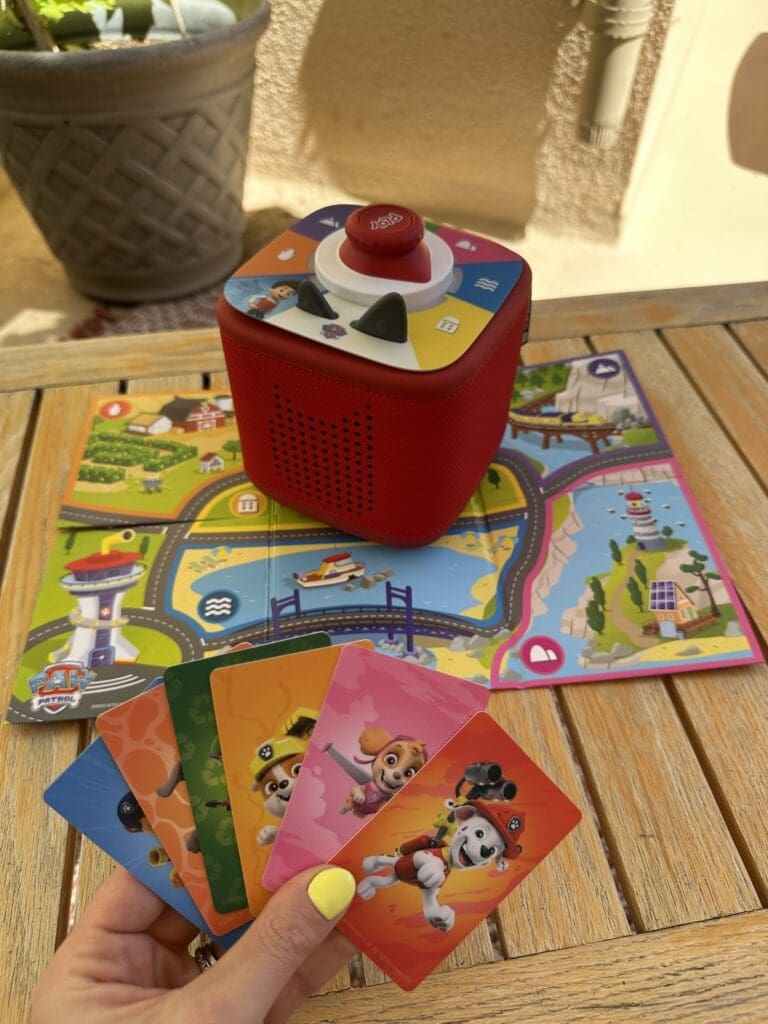
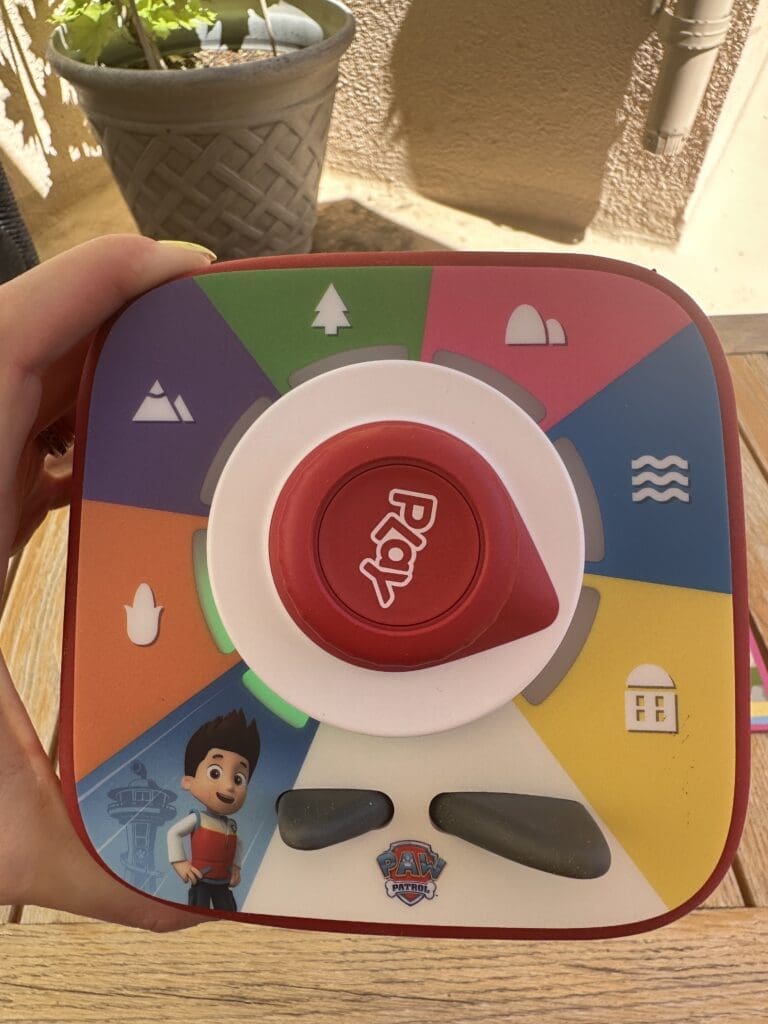
Yoto does not have any gaming feature or function specifically designed to interact with like this.
Winner: Tonies Box
Pros & Cons: Toniebox
Pros
- Intuitive for toddlers, really a net zero learning curve
- Tactile, toy-like experience that’s magical for little kids
- Durable and soft. Designed for the brutality of toddlerhood
- Strong character library
- Creative Tonies allow custom content (up to 90 minutes, reusable)
- Completely screen-free
Cons
- Chapter navigation requires physically hitting the box, with no visual indicator of where you are
- Product and content cost is higher. Every Tonie is $19.99 regardless of what’s on it
- Free content is non-existant without purchasing additional accessories
- Longevity is limited, most kids outgrow it by 5-6
- It does feel like a bit of a collection trap. Once you start buying Tonies, the basket fills up fast
- Battery life (~7 hours) is significantly shorter than Yoto
Pros & Cons: Yoto Player
Pros
- 24-hour battery life
- Yoto Daily and Radio provide free, rotating content indefinitely
- Cards cost less ($9.99–$12.99 vs. $17.99) and hold more content
- Make Your Own cards are incredibly flexible (audiobooks, custom recordings, podcasts, music)
- Functions as nightlight, clock, alarm, routine timer, and Bluetooth speaker
- Parent-controlled volume via app
- Library sharing with other Yoto families
- Scales with your child through elementary school and beyond
- Can be used as okay-to-wake light (7 color options)
Cons
- Less intuitive for the younger toddlers, the buttons and cards require more coordination than placing a figurine
- Cards are small and can get lost or bent — invest in storage early
- The device itself isn’t quite as durable-feeling as the Toniebox
- Setup requires WiFi, and new card content needs to be downloaded before offline use
- Less “wow” factor for a 2-year-old than the figurine mechanic
- More buttons = more time explaining how it works
The Verdict: Tonies vs Yoto, which is best?
Here’s where I land after spending ample time with both:
Buy the Toniebox if:
Your kid is under 3, you want something they can operate independently from day one, and the figurine collect-and-play hunt sounds fun to your family. The Tonies experience for toddlers is special in a way that’s hard to replicate, and if you’re in the thick of that 2-3-year-old window, it’s worth it.
Buy the Yoto Player if:
Your kid is 3+, you want one device that grows with them and does more than play stories, or you’re someone who cringes at the idea of spending $19.99 per piece of content indefinitely. The Yoto is the smarter long-term buy plus value for your money (better battery, better value, better customization, and a free content tier that feels intentional.
If you have a toddler and you want longevity: Some families start with a Toniebox and transition to Yoto around age 4-5. Others skip Tonies altogether and go straight to Yoto, leaning into the figurine-style play in other ways. Both approaches are great.
My honest take of Tonies vs Yoto for our family?
We’ll be using the Toniebox for this season of life and will graduate to Yoto in a few years.
[Shop the Yoto Player →] [Shop the Toniebox →]
Have questions about which one is right for your kid’s age specifically? Drop them in the comments
Frequently Asked Questions Comparing Tonies vs Yoto
Is Tonie vs Yoto better for a 2-year-old? For a 2-year-old, the Toniebox is generally more intuitive. The figurine mechanic is easy to understand and engaging for very young kids. That said, some 2-year-olds do great with the Yoto Mini, it depends on the child.
Is Yoto Player worth the money? Yes, especially compared to Tonies, where content costs add up quickly. The Yoto Player’s free daily content, lower-cost cards, and Make Your Own functionality make it more cost-effective over time.
Can Yoto be used without WiFi? Yes! Once content is downloaded, Yoto works completely offline. The key is to download your cards before you travel. New cards or content require WiFi to download the first time.
What age is Toniebox for? Tonies is marketed for ages 3 and up, though many families start using it closer to 18 months to 2 years. The Toniebox 2 now targets ages 1-9+. Most kids start to outgrow it around 5-6.
How long do Yoto cards last? Yoto cards don’t “expire”, the content is stored in the cloud and tied to your account. As long as Yoto exists as a company, your cards work.
Can you share Yoto cards with friends? Yes. This is a secret hack. Yoto allows library sharing between accounts. If you download the card to your library, you have that content indefinitely and you can both access it.
What is the Yoto Daily? Yoto Daily is a free, new piece of audio content released every single day through the Yoto app. This requires no card. It’s a mix of stories, podcasts, music, and educational content.
Are Tonies worth it? For the right age window (roughly 2-5 years old), yes. For older kids or families wanting one device long-term, Yoto offers more value.
Disclosure: This post about Tonies vs Yoto contains affiliate links. I may earn a small commission if you purchase through my links at no additional cost to you. All opinions are my own. I only recommend products I’ve actually used.


View comments
+ Leave a comment